Skip to content
Summo

Open source · AGPL-3.0 · macOS, Windows, Linux

Meeting notes that
run on your machine.

Speech recognition and speaker attribution run entirely on your computer. The audio never leaves the device — not because we promise it, but because there is no route out.

No account. No cap on meetings.

summo — recording · 12:04

rtf 0.11 · 9× realtime · ram 312 MB · gipformer-65m · offline

Three principles, none of them negotiable

Every engineering decision in Summo follows from these.

Recognition and diarisation are always local

There is no cloud-ASR fallback. On a slow machine Summo suggests a smaller model rather than uploading your audio. Only summarising and answering questions reach outside — and to an endpoint you choose, which can be Ollama on the same laptop.

Press record and it records

A global shortcut, under a second, no questions. Summarising happens after the meeting, because that is when you want it.

Your data is your files

Each meeting is one Markdown file: open it in Obsidian, grep it, sync it with whatever you already use. No database, no proprietary format, no export to request.

This is what it looks like

Real screenshots of the running app, not mockups.

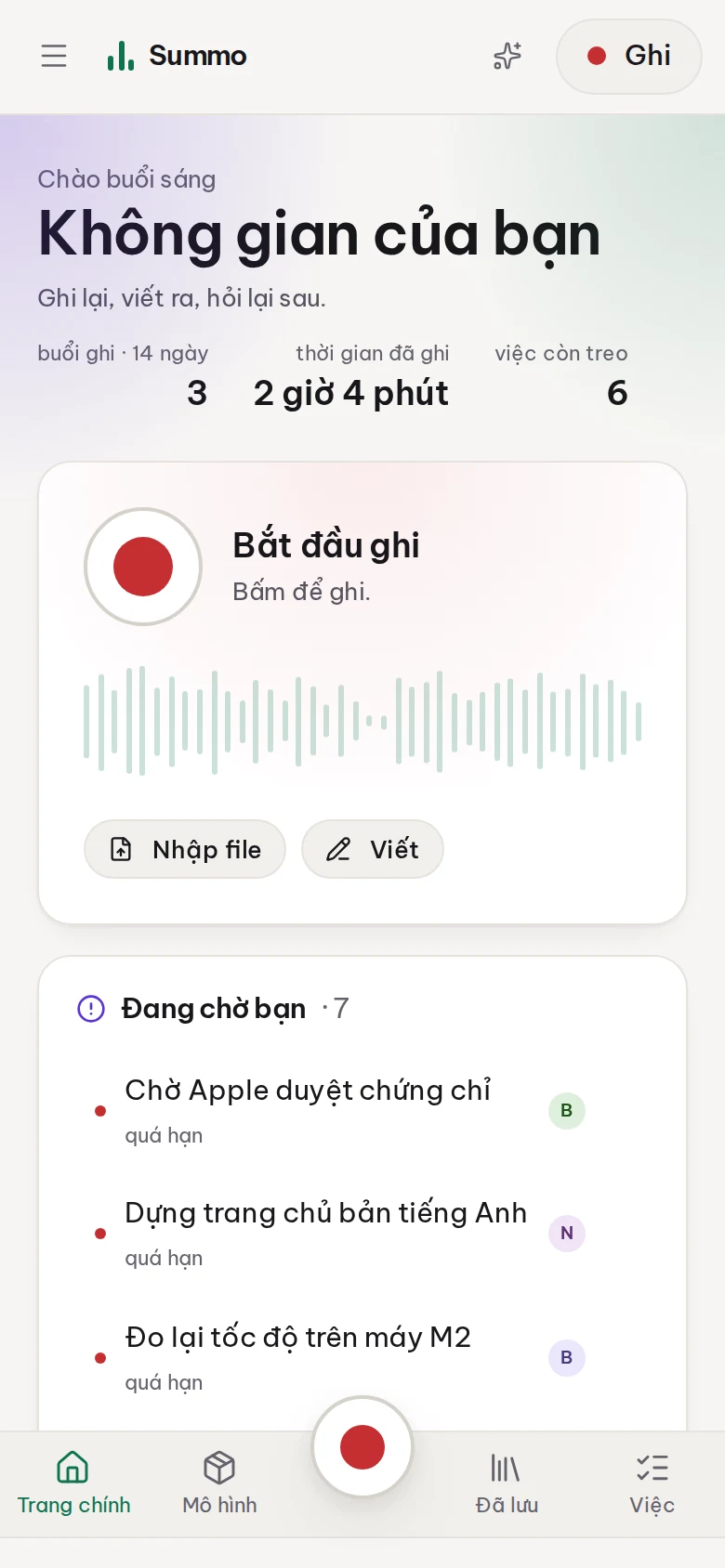
Summo's home screen: the capture panel, the queue waiting on you, and recent recordings.
The vault: recordings and notes, filtered by folder, tag and colour.
Vault — everything recorded and everything written, in one place.
The task board in light mode, four kanban lanes.
Tasks — pulled straight out of the minutes, dragged between lanes.

Measured, not promised

Every figure below has a command that reproduces it. Where it was measured is in the caption; you can run it yourself.

2.4%
Vietnamese WER (Fleurs VI)
summo-bench asr
faster than realtime
summo-bench asr
0.94
voice-activity F1
summo-bench vad
30ms
searching 1,000 meetings
summo-bench vault
Recognition — gipformer-65M, 4 threads
DatasetWERCERRTFNote
Fleurs VI (15 clips, 146s)2.4%1.7%0.024read speech
A real meeting recording (34s)0.107includes re-decoding for live text

That 0.107 includes re-decoding the sentence in progress about ten times so the text follows the speaker. Decoding once costs 0.012 — nine tenths of the budget buys words appearing as they are said, and there is still 9× headroom.

Storage — is a database needed?
MeetingsOn diskSearch (8 threads)List the vaultIndex size
1007 MB4 ms1 ms8 MB
1,00065 MB30 ms5 ms80 MB
5,000327 MB140 ms26 ms402 MB

The answer is no. Five thousand meetings is 327 MB of Markdown, searched in 140 ms — inside the 200 ms where a person starts to notice waiting.

Against the cloud services

Not every comparison table is fair, so this one only lists things checkable from their own pricing pages.

SummoOtter.aiFireflies
Audio leaves your machineNeverYesYes
Works with no networkYesNoNo
A bot joins the callNot neededYesYes
Monthly minute capNoneYesYes
Where your data livesMarkdown filesTheir serversTheir servers
Open sourceAGPL-3.0NoNo
PriceFree$16.99/user$18/user

Otter and Fireflies prices are their lowest paid tier at the time of writing, billed monthly.

Models, like `ollama pull`

There is no "basic" and "premium" tier. Each model is a standalone manifest stating its size, the RAM it needs, its measured speed per CPU class, the languages it covers and its licence. Summo measures your machine and suggests one — you can pick a different one.

Vietnamese, English, and 97 other languages

A Vietnamese-specific transducer for the best speed and accuracy; Whisper for everything else and for sentences that mix Vietnamese and English. Switching models mid-recording does not lose the transcript.

An open registry, with nothing locked to us

Manifests are static JSON in a public repository. If Summo's CDN disappears the app falls back to GitHub and then to the original on HuggingFace. You can host the registry yourself.

Techainer/summo-registry

Pricing

Today there is exactly one thing to pay: nothing. The full application is open source and free, with no limits. The two below are the sync service — not built yet, not for sale, and listed here so you know in advance what would ever cost money and what never will.

Free

$0

forever, open source

  • Unlimited recording and transcription
  • Speaker attribution
  • Translation into 46 languages, on-device
  • Export to MD, SRT, VTT, DOCX, PDF
  • Bring your own LLM key
  • No account
Download
Not yet

Sync

end-to-end encrypted, across your devices

  • Sync between your own machines
  • Voice profiles reused across meetings
  • The server cannot read the contents
Tell me when it exists
Not yet

Team

for organisations

  • Shared workspace and roles
  • Retention policy set by an admin
  • Self-hosting and a commercial licence
Get in touch

We do not sell accuracy. On a slower machine Summo suggests a smaller model — the accuracy changes because of your hardware, not because of what you paid. Recognition and diarisation will stay free and stay local.

Who makes Summo

Techainer — an AI company in Hanoi, founded in 2019.

Techainer builds AI for work that has consequences: video surveillance analytics (Horus), digital identity verification (Master eKYC), document digitisation (DocChain). Over 2 million eKYC registrations and 100,000 banking documents digitised — which is to say our systems run where a mistake is somebody's afternoon.

Summo started as an internal need: meetings held in Vietnamese, minutes written by hand, and nobody willing to upload a recording of an internal meeting to a company in another country. The cheapest way to settle that argument is to make sending it impossible — so recognition runs on the machine, and the source is open so anyone can check that it does.

techainer.com

Founded
2019
Based in
Hanoi, Vietnam
Products
Horus · Master eKYC · DocChain · MLChain
Contact
admin@techainer.com

Thirty seconds to find out

Unpack it and run `./summo serve`. On first launch it measures your machine and asks which model to fetch — nothing is recorded until you press record.

Every download has a `.sha256` beside it — check it first if you are careful.

The first release is being built. In the meantime, `cargo run -p summo-cli -- serve` from source works today.

Questions people ask

"The audio never leaves" — how would I check that?

Three ways. One: the source is open, recognition lives in crates/summo-asr, and there is no HTTP client in it. Two: unplug the network and record — everything still works. Three: firewall the app and the transcript is unchanged. Only summarising and answering questions need the network, and the settings screen states whether the endpoint you chose is local or remote.

Does a bot have to join the call?

No. Summo captures your microphone and your system audio directly, so it works with Zoom, Meet, Teams, a phone call, or people in a room — anything your machine can hear.

How accurate is Vietnamese?

2.4% WER on Fleurs VI with the gipformer-65M model. But Fleurs is clear read speech; a real meeting is much harder, and we have not published a number for real meetings because there is no hand transcript to check against yet. When there is, it will sit beside this one.

Does translation run locally?

Yes. As of this version, translation into 46 languages runs on a model inside the app — no Ollama, no network. Only summarising and question-answering call a language model, and you choose that endpoint.

What if my machine is slow?

On first launch Summo measures it for fifteen seconds and picks a pair of models to match. The default Vietnamese model is 73 MB and runs 9× faster than realtime on four CPU cores — no GPU.

Where is my data?

A folder of Markdown in your application data directory. Open it in Obsidian, grep it, put it in git. Audio is stored as Opus and deleted after 30 days by default while the transcript is kept — both configurable.

How can it be AGPL and still be a business?

The app and the core are AGPL-3.0, so nobody can take it and run a closed service on it. What would be paid for later is the sync service, which lives in its own repository and is not needed to run the app. A company that needs to be free of the AGPL buys a commercial licence.